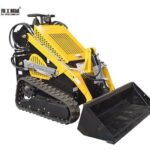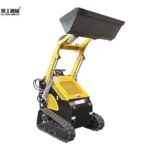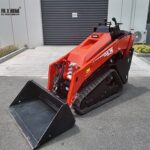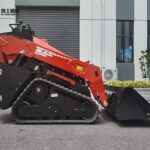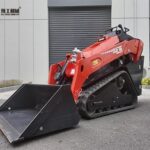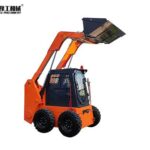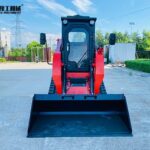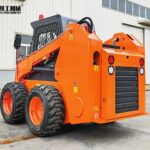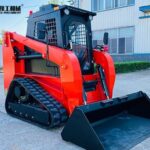
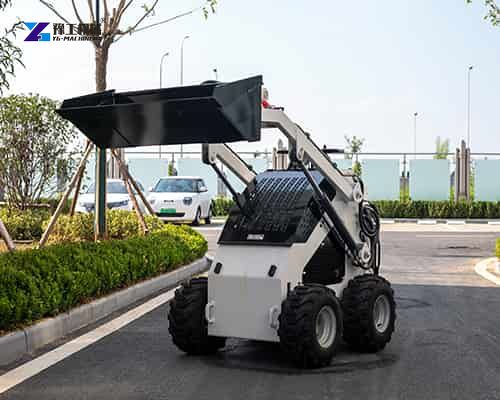
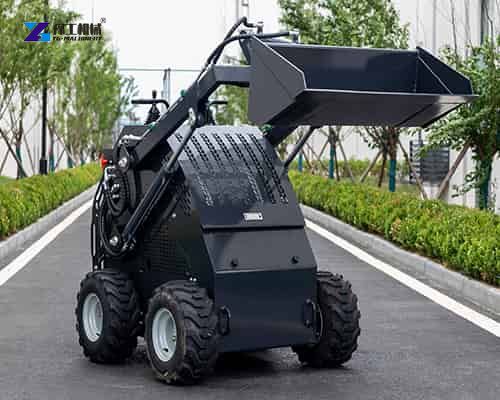
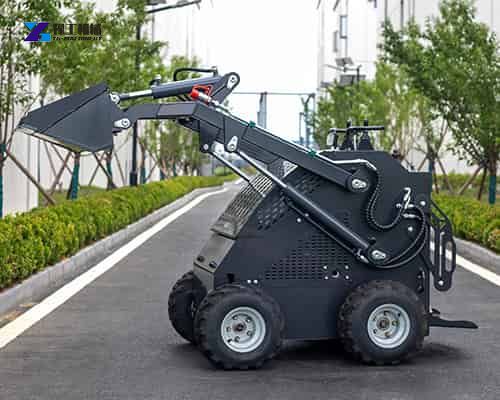
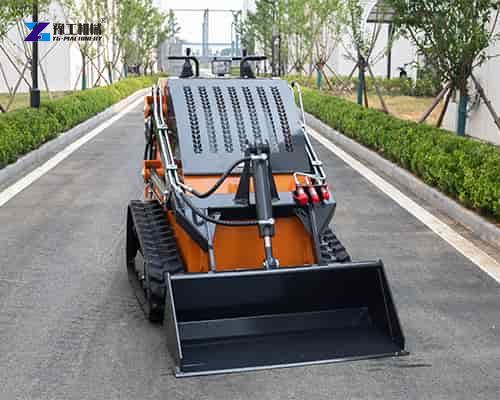
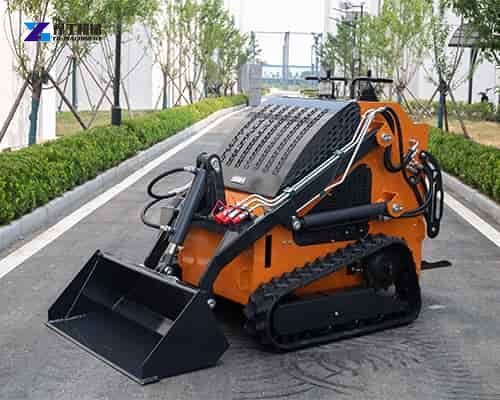
Small stand-on skid steer is a compact, self-propelled loader that allows the operator to stand on a rear platform rather than sit inside a. Its compact chassis, front-mounted bucket, and hydraulic lifting arms make it suitable for moving materials and performing light-to-medium-duty site preparation work. Unlike larger compact track loaders, stand-on machines prioritize a small operating footprint, direct visibility of the attachment, and convenient access in restricted spaces. These characteristics are particularly useful when working between buildings, along garden paths, inside residential yards, or around existing landscaping. Depending on the configuration, the machine may be powered by a battery-electric system or a diesel engine. Electric models can be attractive for noise-sensitive environments and operations seeking to reduce local exhaust emissions, while diesel models provide an alternative for demanding outdoor applications and job sites where refueling is more convenient than battery charging. If you need this machine, please contact us, and we will reply to you as soon as possible.
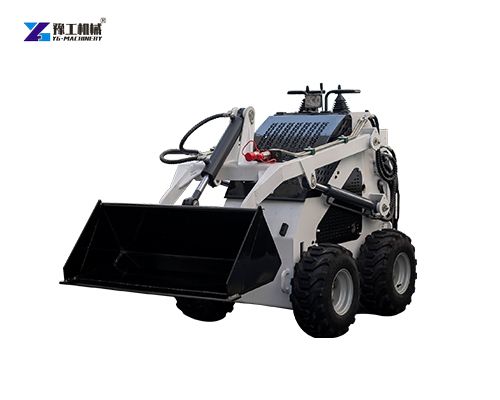
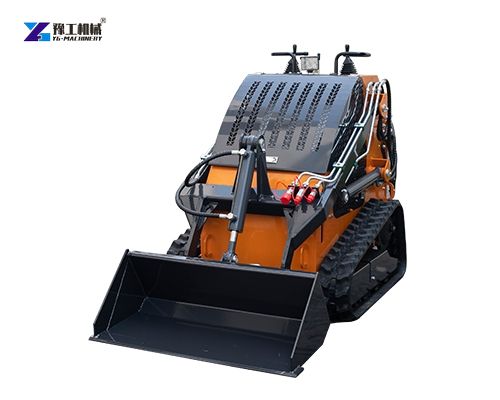
Specifications of the Small Stand-on Skid Steer
| Item | S360 | S460 | T480 | S490 | V800 | V1000 |
| Basic performance parameters | ||||||
| Operating weight | 880kg | 1060kg | 1321kg | 1200kg | 1729kg | 1892kg |
| Bucket capacity | 0.1m³ | 0.1m³ | 0.1m³ | 0.1m³ | 0.15m³ | 0.19m³ |
| Climbing ability / Gradeability | 25° | 25° | 25° | 25° | 25° | 25° |
| Maximum breakout force | 3.5KN | 4.5KN | 4.5KN | 4.5KN | 4.5KN | 4.5KN |
| Rated load | 200kg | 300kg | 350kg | 250kg | 420kg | 500kg |
| Maximum load | 300kg | 400kg | 450kg | 350kg | 500kg | 650kg |
| Travel speed | 0-6km/h | 0-6km/h | 0-5km/h | 0-6km/h | 0-4km/h | 0-6km/h |
| Vehicle width | 1000mm | 1110mm | 1040mm | 1089mm | 911mm | 960mm |
| Rated pressure | 16Mpa | 16Mpa | 16Mpa | 16Mpa | 16Mpa | 17 20Mpa |
| Bucket width | 1050mm | 1050mm | 1050mm | 1150mm | 1020mm | 1240mm |
| Max loading height | 1680mm | 1680mm | 1720mm | 1650mm | 2000mm | 2102mm |
| Max dumping height / Maximum unloading height | 1367mm | 1370mm | 1401mm | 1382mm | 1704mm | 1522mm |
| Max operating height / Maximum height | 2400mm | 2290mm | 2110mm | 2466mm | 2873mm | 2794mm |
| Height to bucket pin | 1840mm | 1835mm | 1870mm | 1877mm | 2195mm | 2140mm |
| Max height bucket dump angle | 63° | 63° | 63° | 63° | 32° | 63° |
| Min height | 1300mm | 1300mm | 1300mm | 1300mm | 1573mm | 1548mm |
| Departure angle | 21° | 18° | 22° | 15° | 39° | 29° |
| Ground clearance / Distance from ground | 130mm | 125mm | 157mm | 200mm | 225mm | 200mm |
| Dumping distance | 258mm | 261mm | 295mm | 550mm | 371mm | 498mm |
| Wheelbase / Track contact length | Wheelbase 710mm | Wheelbase 760mm | Track 900mm | Wheelbase 940mm | 1200mm | 1080mm |
| Dimensions / Size | ||||||
| Overall dimensions | 2130*1050*1300mm | 2194*1050*1300mm | 2169*1120*1300mm | 2573*1150*1300mm | 2651*1020*1573mm | 2691*1240*1548mm |
| Length including bucket / Include Bucket length | 2130mm | 2194mm | 2169mm | 2573mm | 2651mm | 2691mm |
| Length excluding bucket / Does not include bucket length | 1726mm | 1770mm | 1850mm | 2100mm | 2084mm | 1981mm |
| Tire / Track model | 18*8.5-8 | 18*8.5-8 | 180*72*35 | 23*8.5-12 | 180*72*45 | 230*72*45 |
| Engine | ||||||
| Brand | Lithium electricity/KOOP/Rato/B&S | Lithium electricity/KOOP/Rato/B&S | Yanmar/Kubota | Lithium electricity/KOOP/Rato/B&S | Kubota | Yanmar/Kubota |
| Model | Lead-acid battery/192FH/R420D/XR13.5 | Lithium iron phosphate/292F/R740/Vanguard23 | 3TNV80/D1105 | Lithium iron phosphate/292F/R740/Vanguard23 | D1105 | 3TNV80/D1105 |
| Rated power | 6kw,72V,125ah/7.6(7)/7.9/9.92kw | 8kw,72V,200ah/15/16.8/17kw | 15.2(17.8)/17.1kw | 8kw,72V,200ah/15/16.8/17kw | 17.1(18.2)kw | 15.2(17.8)/17.1kw |
| Cylinder | 1 | 2 | 3 | 2 | 3 | 3 |
| Intake method | Natural inhalation | Natural inhalation | Naturally aspirated | Natural inhalation | Natural inhalation | Natural inhalation |
| Emission standard | EPA/EURO5 | EPA/EURO5 | EPA/EURO5 | EPA/EURO5 | EPA/EURO5 | EPA/EURO5 |
| Fuel tank capacity | 5L | 10L | 13L | 10L | 33L | 40L |
Several Models of the Compact Stand-on Skid Steers for Sale in YG Machinery
S360: For Light-Duty Work and Compact Electric Operation
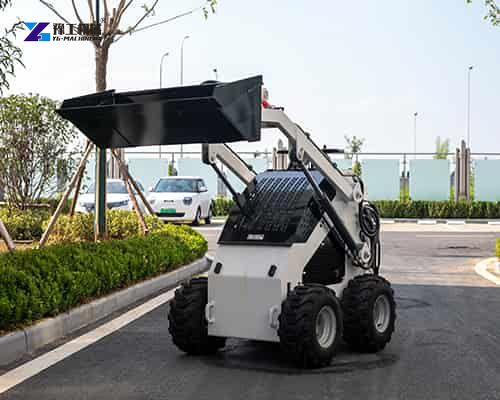
The S360 is a suitable starting point for buyers who prioritize lighter material-handling tasks and an electric power option. Its 200 kg rated capacity and approximately 1,000 mm width make it worth considering for garden maintenance, small landscaping projects, and routine property work.
Choose this model when the expected workload is relatively light and its lifting capacity meets your requirements
S460: For a Higher Capacity Electric Configuration
With a rated capacity of 300 kg, the S460 offers more listed lifting capacity than the S360 while retaining an electric power option.
Its approximately 1,110 mm width means buyers should pay particular attention to access clearance. It may suit projects where electric operation and additional capacity are more important than passing through the narrowest openings.
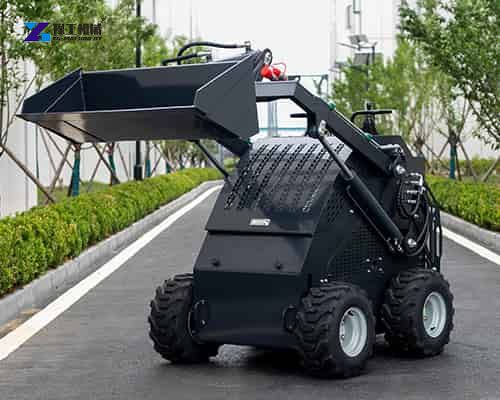
T480: For General Construction and Landscaping Tasks
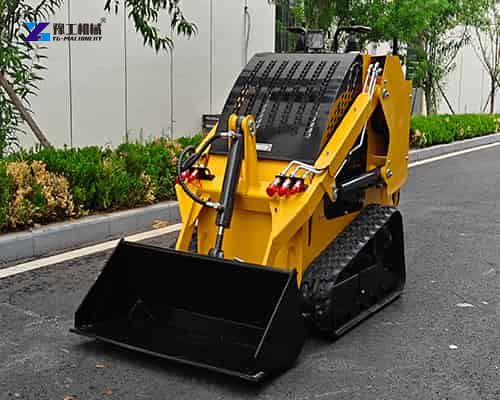
The T480 provides a 350 kg rated capacity, approximately 1,040 mm vehicle width, and 1,720 mm maximum loading height.
It is worth evaluating for routine construction support, material distribution, and landscaping work that requires a balance between machine size and lifting capability.
S490: For Compact Electric Material Handling
The S490 combines a listed 250 kg rated capacity with a 1,089 mm width and a 1,650 mm maximum loading height. It may be suitable for buyers seeking an electric configuration for regular material-handling tasks.
V800: For Narrow Access with Higher Rated Capacity
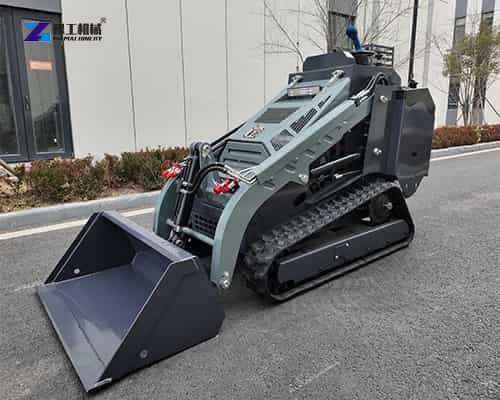
The V800 stands out with a listed width of approximately 911 mm, a 420 kg rated capacity, and a 2,000 mm maximum loading height.
For contractors who need to move heavier materials through restricted access routes, it is a model worth shortlisting. Its suitability still depends on the actual gate clearance, load characteristics, ground conditions, and required dumping geometry.
V1000: For Higher-Capacity Material Handling
The V1000 offers the highest rated capacity in this lineup at 500 kg, along with a maximum loading height of approximately 2,102 mm.
It is a strong candidate for buyers whose regular workload demands greater lifting capacity and higher material placement. Before selecting it, check that the machine’s width, overall height, transport arrangements, and operating limits match the intended jobsite.
How Does a Stand-On Mini Skid Steer Work?
The machine combines a compact drive system with hydraulic controls and lifting arms to move materials efficiently across a jobsite.
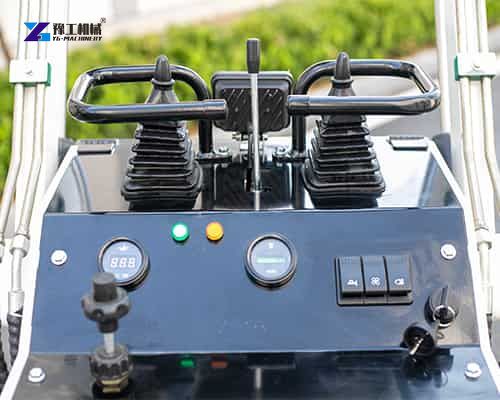
The operator controls the machine’s travel direction and speed from the standing platform. The drive system allows the loader to maneuver within a small working area, while the hydraulic system operates the bucket and lifting mechanism.
During a typical loading cycle, the operator positions the bucket near the material, lowers the attachment, drives forward to collect the load, and raises the lifting arms to transport or discharge the material. The bucket can then be tilted to unload soil, aggregate, mulch, or other suitable materials into a designated area.
Depending on the machine’s hydraulic configuration and attachment interface, compatible accessories may expand its capabilities beyond standard bucket work. Potential applications include landscaping preparation, debris handling, light grading, and other material-handling operations. Always verify the required hydraulic flow, mounting interface, and rated capacity before selecting an attachment.
This straightforward operating principle helps reduce repetitive manual labor while giving operators greater control over material movement in confined work areas.
Benefits of a Small Stand-On Skid Steer
The right compact loader should do more than move materials. It should help your team work efficiently, access restricted areas, and select equipment that fits the actual demands of each project.
1. Compact Dimensions for Restricted Access
Machine width is one of the most important purchasing considerations for residential landscaping and property maintenance.
The S360 measures approximately 1,000 mm wide. The V800 is narrower still, at about 911 mm, making it a model worth considering for particularly restricted access routes.
These dimensions can help buyers assess whether a machine may pass through gates, garden access points, and other narrow openings. Actual suitability depends on the clear opening width, attachment dimensions, maneuvering clearance, and ground conditions.
2. Multiple Capacity Options for Different Workloads
Not every job requires the same lifting performance. Choosing a machine with an appropriate rated capacity helps balance productivity, operating weight, and overall equipment cost.
The seven-model range offers rated capacities from 200 kg on the S360 to 500 kg on the V1000. Intermediate options include the S460 at 300 kg, T480 at 350 kg, and V800 at 420 kg.
This range allows contractors to select a machine based on the materials they handle most frequently instead of paying for unnecessary capacity or operating a machine that is undersized for the task.
3. Efficient Material Handling with a Front Bucket
A front bucket supports routine tasks such as moving soil, transferring mulch, collecting loose debris, and distributing aggregate.
Bucket widths vary across the lineup, from approximately 1,020 mm on the V800 to 1,240 mm on the V1000. A wider bucket may cover more ground per pass when handling suitable loose materials, while a narrower bucket may be preferable in restricted working areas.
The best bucket size depends on material density, available access space, and the machine’s rated capacity. Bucket volume alone should never be used to determine a safe payload.
4. Useful Lifting Height for Loading and Placement
Lifting height determines how effectively a compact loader can place materials into designated areas.
The V800 provides a listed maximum loading height of approximately 2,000 mm, while the V1000 reaches approximately 2,102 mm. These specifications make the larger models worth evaluating for jobs that involve loading suitable materials into compatible containers or placing material at a higher level.
Buyers should distinguish maximum loading height from maximum unloading height and bucket-pin height. These measurements describe different points in the lifting geometry and should be checked against the actual receiving equipment.
5. Electric and Diesel Power Choices
Different jobsites have different power requirements, operating-hour expectations, and emissions considerations.
The S360 and S460 are available in configurations listed with lithium-electric power options, while T480, S490, V800, and V1000 specifications include diesel engine configurations or engine-based options.
Electric versions may suit smaller properties and operations where reducing on-site exhaust emissions is a priority. Diesel models may be more appropriate for extended outdoor work or locations where charging infrastructure is limited.
Because battery chemistry, charging requirements, engine configurations, and rated power vary, buyers should confirm the exact powertrain supplied with their selected model.
6. A Choice of Compact Models for Different Budgets and Priorities
A practical equipment investment starts with matching the machine to the work rather than selecting the largest available option.
The S360 may appeal to buyers prioritizing compact electric operation and lighter loads. The S460 offers a higher rated capacity, while the V800 combines a narrow listed width with a 420 kg rated capacity. For heavier material-handling requirements, the V1000 provides a rated capacity of 500 kg and a listed maximum loading height of 2,102 mm.
By comparing capacity, dimensions, powertrain, and working height together, buyers can identify a configuration that supports their productivity goals without overlooking access limitations or operating requirements.
Applications of a Small Stand-On Skid Steer
The versatility of compact loaders makes them useful across several industries, particularly where full-size equipment is difficult to maneuver or unnecessary for the task.
Landscaping and Garden Construction
Move soil, spread mulch, transport aggregate, and assist with garden renovation. Compact dimensions can help reduce access challenges on residential properties, although ground protection and surface conditions should always be considered.
Residential Construction and Renovation
Support site preparation, move suitable building materials, and clear loose debris from designated work areas. Select the rated capacity according to the actual load and attachment configuration.
Property Maintenance and Facility Management
Help maintain commercial grounds, move landscaping materials, and complete repetitive outdoor handling tasks. Electric configurations may be worth considering where local noise or exhaust-emission requirements influence equipment selection.
Agriculture and Small Farm Operations
Move loose feed, soil, compost, and other suitable materials around barns, yards, and storage areas. Material density, surface conditions, ventilation, and attachment suitability are important when working in agricultural environments.
Nurseries and Greenhouse Projects
Compact loaders can support soil handling, potting-material transport, and general site preparation where access is limited. Check the machine’s overall dimensions, floor loading limits, and turning clearance before operating indoors or within greenhouse structures.
Paving and Hardscape Installation
Transport suitable aggregates, move bedding materials, and support preparation work for walkways and patios. Correct bucket sizing and controlled material placement can help streamline repetitive tasks.
How to Choose the Right Small Stand-On Skid Steer
Before placing an order, evaluate the following factors to reduce the risk of buying equipment that does not fit your daily workload.
1. Measure access clearance. Check the narrowest gate, pathway, doorway, or work area. Include clearance for the bucket, controls, and safe maneuvering.
2. Estimate your typical load. Identify the materials you move most often and calculate their approximate weight. Leave an appropriate margin below the applicable rated capacity.
3. Compare loading and unloading geometry. Confirm that the maximum loading height, unloading height, and bucket dump angle match the receiving container or work area.
4. Select the appropriate powertrain. Compare electric and diesel configurations according to expected operating hours, charging access, refueling availability, ventilation, noise requirements, and maintenance arrangements.
5. Review transport and storage requirements. Consider overall dimensions, machine weight, trailer capacity, loading arrangements, and available storage space.
A well-matched compact loader can contribute to a more efficient workflow, but the right choice depends on the complete operating environment rather than one headline specification.
Why Choose Our Compact Stand-On Loader Range?
Selecting compact construction equipment is a long-term operating decision. Beyond the purchase price, buyers should consider the machine’s suitability for daily tasks, ease of access, maintenance requirements, and compatibility with the tools they already use.
Our multiple model lineup gives buyers multiple options for comparing lightweight electric configurations with higher-capacity diesel models. Instead of relying on a single machine size, you can evaluate rated capacity, overall dimensions, loading height, and hydraulic specifications against your actual project requirements.
We recommend discussing your application with us. If you can provide your typical material type, required lifting height, minimum access width, preferred power source, and intended attachments so that the proposed configuration can be checked against your needs.