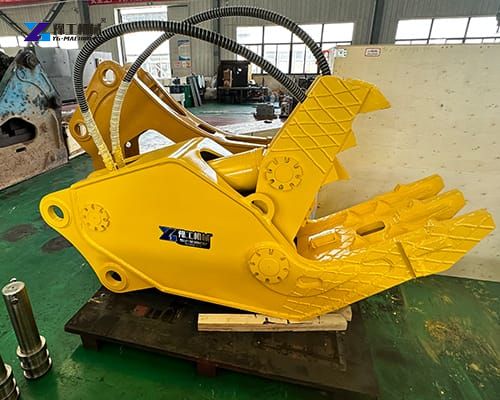
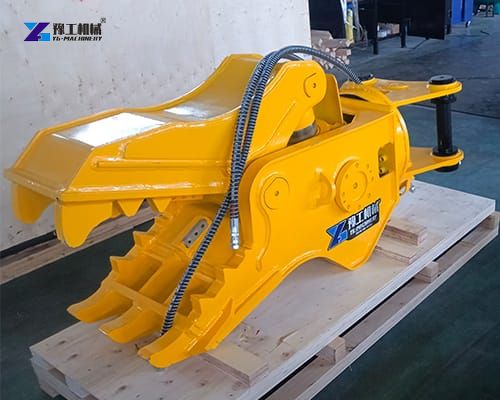
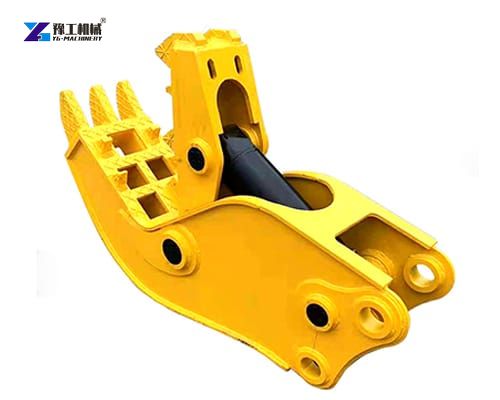
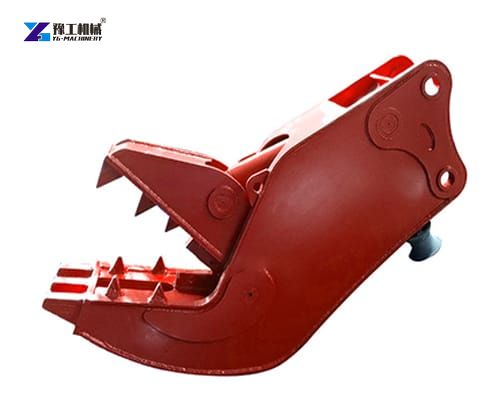
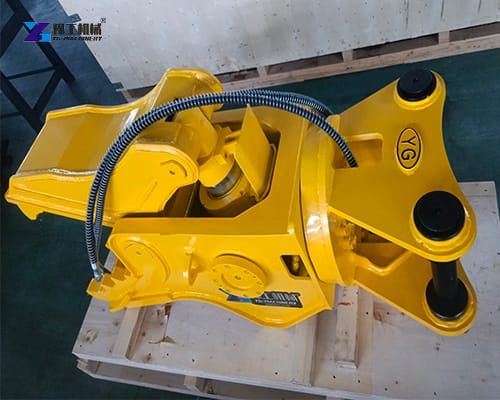
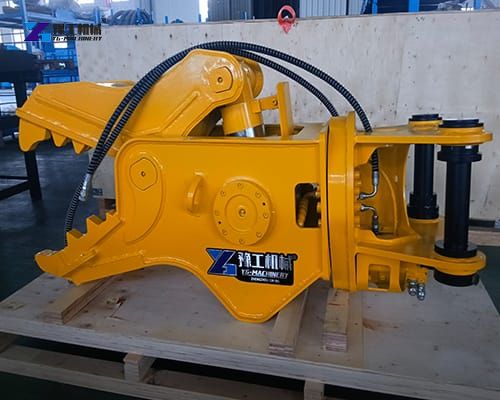
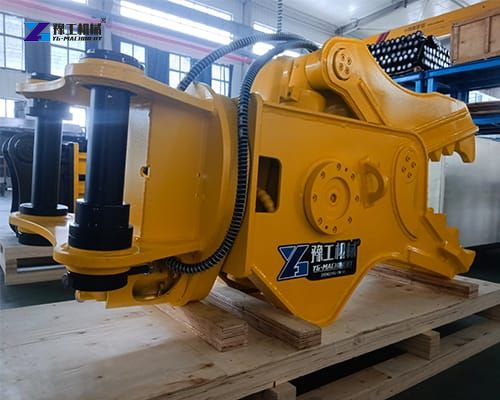
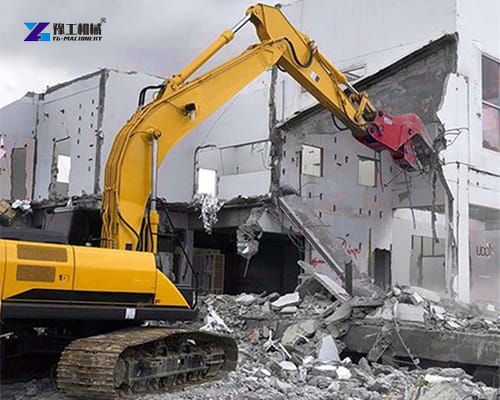
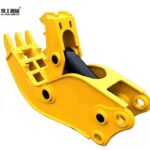
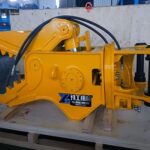
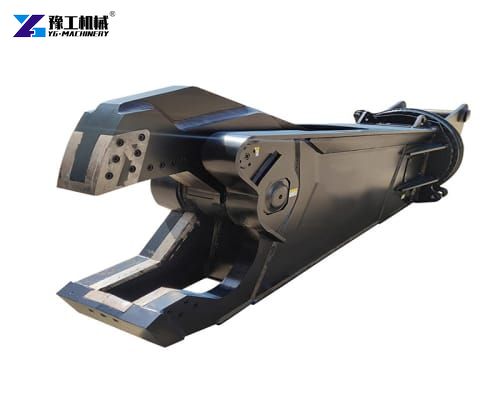
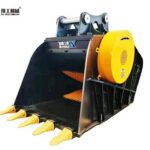
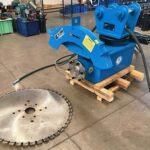
Concrete pulverizer for excavator is a hydraulic demolition attachment designed to reduce reinforced and non-reinforced concrete structures into manageable pieces. By mounting directly to a compatible excavator, this attachment gives demolition projects a practical solution for secondary concrete processing, site cleanup, and material preparation. The excavator concrete pulverizer applies controlled crushing force through opposing jaws. This makes it useful when the goal is not simply to break concrete, but to reduce it into smaller fragments that are easier to handle, sort, transport, and recycle.
The attachment is powered by the excavator’s hydraulic system, making a concrete pulverizer for excavator work as an integrated part of the carrier machine. Hydraulic pressure drives the jaw mechanism, bringing the upper and lower jaws together with high crushing force. Concrete is caught between the jaw surfaces and progressively fractured as the operator controls the excavator arm and attachment.
The crushing action is mechanical and repeatable. Instead of depending on impact alone, the jaws use compressive force to break slabs, beams, walls, and other concrete sections. This operating principle can help operator achieve more controlled material reduction while working directly at the demolition site.
A properly matched excavator pulverizer attachment should be selected according to excavator operating weight, hydraulic capability, attachment dimensions, and the nature of the demolition work. Correct matching is essential for stable operation, productive cycle times, and long-term component durability.
A concrete pulverizer for excavator is primarily intended for concrete demolition and size reduction. Typical applications include:
Reinforced concrete from buildings and industrial structures
Concrete slabs and floors
Precast concrete sections
Concrete walls and columns
Road and pavement concrete
Demolition debris requiring secondary reduction
Concrete fragments prepared for sorting and recycling
The attachment is especially valuable when a project needs to turn large demolition pieces into smaller, more manageable material. Where reinforcing steel is present, the crushing process can also make subsequent separation and handling easier, depending on the material condition and site process.
Advantages of This Concrete Pulverizer for Excavator
1. High Crushing Force for Demanding Demolition
The range is engineered for substantial hydraulic crushing performance. Depending on the model, maximum shear force ranges from 380 KN on the YG400 to 2,503 KN on the YG1700. This broad range allows people to select a machine that fits the scale of their work.
2. Multiple Models for Different Excavator Sizes
The lineup covers excavators from approximately 6–9 tons up to 50–80 tons. This makes the concrete pulverizer for excavator suitable for both compact-to-mid-size demolition equipment and heavy-duty machines used on large structural projects.
3. Purpose-Built Jaw Geometry
The upper and lower jaw widths vary by model, providing different working capacities across the series. For example, the YG400 has a 215 mm upper jaw and 458 mm lower jaw, while the YG1700 reaches 400 mm and 812 mm respectively. This scaling supports different material sizes and operating requirements.
4. Strong Opening Capacity
Maximum opening height increases from 587 mm on the YG400 to 1,400 mm on the YG1700. A larger opening helps operators engage bigger concrete sections without repeatedly repositioning the excavator.
5. Designed Around Hydraulic Operation
All models of concrete pulverizer for excavator are listed with a working pressure of 280–320 bar, supporting integration with appropriately configured excavator hydraulic systems. This hydraulic design allows the excavator to provide the power source without requiring a separate crushing machine at the point of demolition.
6. Broad Working Reach Through Excavator Mounting
Because the attachment is installed on an excavator boom, operators can work from a controlled position and access elevated, recessed, or difficult-to-reach sections. The excavator pulverizer attachment can therefore become a flexible part of a demolition fleet rather than a standalone processing unit.
7. Scalable Blade and Jaw Dimensions
Blade length grows from 120 mm on the YG400 to 240 mm on the YG1700. The progressive sizing of the working components helps match attachment capacity to excavator class and project scale.
8. A Practical Option for Secondary Concrete Processing
After primary demolition, large concrete pieces can create handling and transportation problems. A concrete pulverizer for excavator can reduce oversized fragments on site, helping contractors prepare material for loading, sorting, stockpiling, or downstream recycling.
9. Heavy-Duty Construction Across the Series
Operating weight ranges from 670 kg for the YG400 to 4,709 kg for the YG1700. The increasing attachment mass corresponds with the larger excavator classes and higher working capacity of the series. Proper machine matching remains important for safe and efficient operation.
10. One Attachment for Multiple Demolition Workflows
Concrete reduction is often only one stage of a demolition project. By combining excavator mobility with hydraulic crushing, the attachment can support concrete processing, debris reduction, site clearing, and recycling preparation within the same work area.
For commercial, residential, and industrial demolition, the jaws can reduce concrete sections after primary dismantling. This helps make debris easier to manage and can support more organized site operations.
2. Road and Infrastructure Projects
Concrete pavement, bridge components, and other infrastructure materials may require controlled size reduction before removal or recycling. A properly matched attachment can perform this work directly from the excavator.
3. Concrete Recycling Preparation
Recycling facilities and contractors often need demolition concrete reduced to a practical size before further processing. On-site crushing can help reduce oversized material before transportation or downstream sorting.
4. Site Cleanup and Material Handling
After a structure is demolished, irregular concrete fragments can occupy significant space. Reducing those fragments can make loading and stockpiling more efficient and help keep the work area organized.
Model selection should start with the excavator rather than the attachment alone. The recommended excavator weight range is one of the clearest references in the specification table.
YG400 — For 6–9 Ton Excavators
A compact option for smaller demolition jobs, concrete slabs, interior structural work, and site cleanup where maneuverability matters.
YG600 — For 10–15 Ton Excavators
A mid-size solution for general demolition contractors handling concrete structures and moderate-volume debris.
YG800 — For 18–26 Ton Excavators
A stronger choice for larger structural demolition, roadwork, and projects requiring greater jaw capacity and crushing force.
YG1000 — For 26–30 Ton Excavators
Designed for high-capacity excavators and more demanding concrete processing tasks, with a 1,029 mm maximum opening height and 2,250 KN maximum shear force.
YG1700 — For 50–80 Ton Excavators
The largest model in the range, intended for heavy demolition operations. Its 1,400 mm opening height, 2,503 KN maximum shear force, and 4,709 kg operating weight reflect its heavy-duty positioning.
When choosing an excavator pulverizer attachment, it’s better to confirm hydraulic flow, pressure, mounting dimensions, carrier stability, and the attachment’s intended operating environment. Are you looking for the pulverizer attachment for your excavator? Do not hesitate to contact us and we will reply to you as soon as possible.
We use cookies to ensure that we give you the best experience on our website. If you continue to use this site we will assume that you are happy with it.